
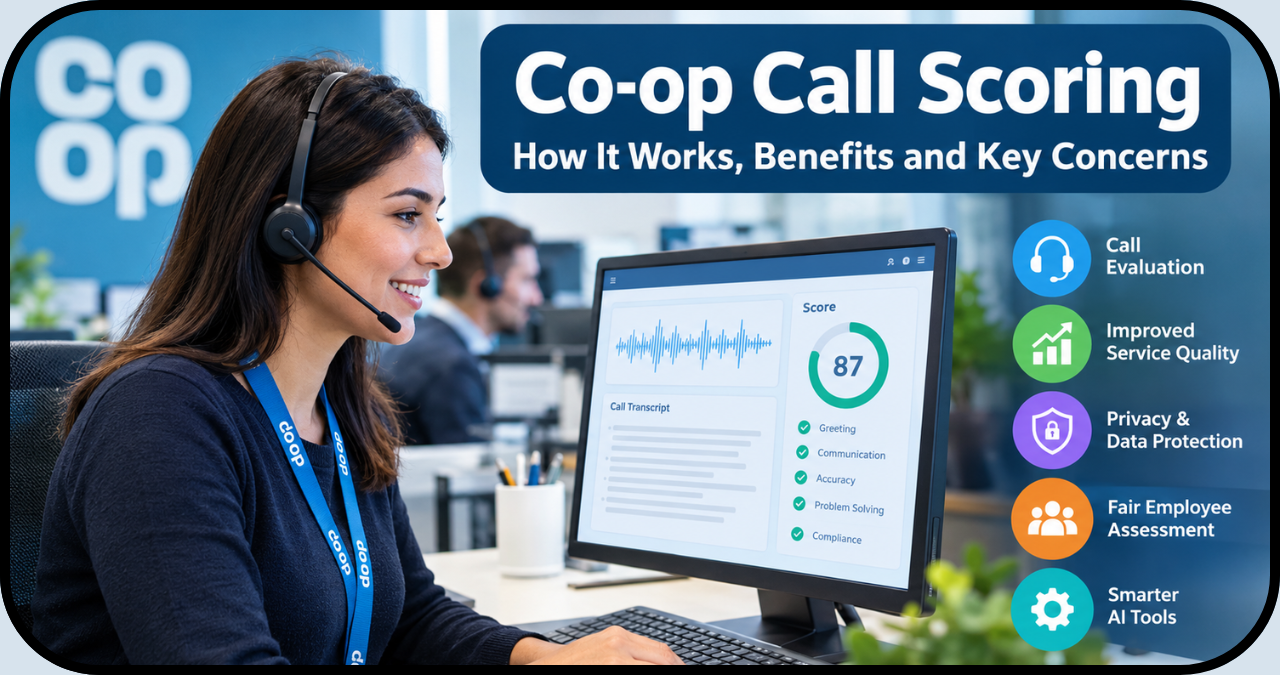
Co-op Call Scoring refers to the idea of evaluating customer service calls associated with a cooperative organisation or a business known as Co-op. Call scoring generally involves reviewing conversations between customers and service representatives to assess communication quality, accuracy, professionalism, and compliance with company procedures. The purpose is to understand how effectively a representative handles customer enquiries and identifies areas where service can improve. However, the precise meaning of Co-op Call Scoring depends on the organisation and system being discussed. Without a confirmed description of a particular Co-op programme, its internal scoring methods and official procedures cannot be stated as established facts.
In customer service environments, call scoring is often part of a broader quality assurance process. Supervisors, trained evaluators, or software tools may assess conversations against a set of predefined standards. These standards can cover greeting customers appropriately, understanding their concerns, providing accurate information, explaining solutions clearly, and maintaining a professional tone. Organisations can then use the findings to improve training and customer experiences. When researching a specific Co-op system, it is important to distinguish these general industry practices from details that the organisation has officially confirmed.
Why Businesses Use Call Evaluation Systems
Customer service teams handle different types of enquiries every day, ranging from straightforward information requests to complicated complaints. Without a consistent evaluation process, it can be difficult to determine whether customers receive the same standard of support across different representatives and departments. Call evaluation provides a structured way to examine conversations and identify recurring problems. It can also help managers understand which procedures work effectively and which require improvement.
A well-designed evaluation process focuses on service quality rather than simply counting mistakes. For example, a representative might follow every required procedure but still struggle to explain a solution clearly. Another employee might communicate warmly but provide incomplete information. Reviewing these situations against consistent standards helps organisations identify the specific skills that need attention. The objective is to develop a more reliable customer experience while giving employees clear expectations about their responsibilities.
How the Call Scoring Process Typically Works
A typical call-scoring process begins with selecting customer interactions for review. Depending on the organisation’s policies, these interactions may be assessed through recorded calls, live monitoring, or other approved quality assurance methods. The reviewer then compares the conversation with an established evaluation framework. That framework may include communication skills, accuracy, customer identification procedures, problem-solving, and adherence to relevant policies. The precise criteria vary between organisations and should not be assumed to be identical across all Co-op businesses.
After reviewing a conversation, the evaluator records the results against the applicable criteria. Some systems use numerical points or percentage scores, while others rely on descriptive ratings and written feedback. The results may help identify patterns across a team, such as repeated misunderstandings or difficulties with a particular process. Managers can use these observations to organise coaching sessions and revise training materials. A score is most useful when it explains what happened during a conversation and how the employee can improve, rather than simply producing a number without meaningful context.
Important Criteria Used to Assess Customer Calls
Communication is one of the most common areas considered in customer service evaluations. Representatives may be assessed on whether they listen carefully, speak clearly, ask relevant questions, and explain information in language customers can understand. Respectful communication is particularly important when customers are confused, frustrated, or dealing with an unexpected problem. An effective conversation should help customers understand their available options without unnecessary complexity or pressure.
Accuracy and problem-solving are also important evaluation areas. A representative should provide information that matches current procedures and the customer’s circumstances. Reviewers may examine whether the employee understood the original enquiry, identified the relevant issue, and explained an appropriate next step. Where a problem cannot be resolved immediately, clear communication about the next stage can still contribute to a positive experience. The applicable standards will depend on the organisation’s policies, the nature of the enquiry, and any relevant legal or regulatory requirements.
The Role of Artificial Intelligence in Call Scoring
Artificial intelligence can support call evaluation by analysing certain features of customer conversations. Depending on the software, these features may include speech transcription, keyword identification, conversation summaries, and indicators of whether specific topics were discussed. Some systems can help reviewers identify calls that may require closer examination, reducing the time needed to locate relevant sections of a conversation. These capabilities can make quality assurance more scalable, particularly for organisations handling large numbers of customer interactions.
However, AI-generated assessments have limitations. Speech recognition can misunderstand accents, background noise, unfamiliar names, or specialist terminology. Automated systems may also miss the context behind a customer’s words or fail to recognise when a representative has handled an unusual situation appropriately. For this reason, an AI-generated score should not automatically be treated as a complete or objective judgement of an employee’s performance. Human review, appropriate testing, and clear procedures for challenging inaccurate results can help reduce these risks. There is no basis here to conclude that a particular Co-op operation uses any specific AI scoring system.
Potential Benefits for Customer Service Teams
A consistent call evaluation framework can help businesses identify training needs more accurately. Instead of relying only on general impressions, managers can use documented examples to explain where communication or problem-solving could improve. Employees can receive more specific guidance, making coaching sessions more practical and easier to apply during future customer conversations. Over time, this approach may support more consistent service across different teams and departments.
Call evaluation can also reveal problems that extend beyond individual employees. If several representatives struggle with the same question, the underlying issue might be unclear guidance, outdated information, or a complicated internal process. Identifying such patterns gives managers an opportunity to improve documentation and operational procedures. The benefits depend on how the findings are used. A system focused exclusively on numerical scores may provide limited value, while one that combines fair assessment, useful feedback, and ongoing improvement can offer a more complete picture of service quality.
Employee Performance Monitoring and Fair Assessment
Call scoring can influence how managers understand employee performance, making fairness an essential consideration. A single conversation may not accurately represent an employee’s overall ability, particularly when the call involves an unusual complaint, a technical issue, or circumstances outside the representative’s control. Evaluation systems should therefore use clear criteria and, where appropriate, examine a suitable range of interactions rather than drawing broad conclusions from one isolated result.
Employees should also understand what is being assessed and how the results may be used. Transparent expectations allow representatives to prepare appropriately and recognise the difference between required procedures and optional communication techniques. Constructive feedback should explain the evidence behind an assessment and give employees a reasonable opportunity to clarify relevant circumstances. Where scores affect formal performance decisions, organisations should consider suitable review and appeal procedures. These safeguards can help build trust while ensuring that quality assurance remains focused on meaningful improvements.
Privacy, Call Recording and Data Protection
Customer conversations can contain personal information, account details, complaints, and other sensitive material. Any organisation that records or analyses calls must consider the privacy implications of collecting and using this information. Appropriate practices may include explaining recording arrangements where required, restricting access to authorised personnel, establishing suitable retention periods, and protecting recordings from unauthorised disclosure. The precise legal obligations depend on the location, purpose of processing, and circumstances in which the information is collected.
Employee monitoring raises additional questions because call evaluations may be used to assess individual performance. Organisations should explain the purpose of monitoring, identify who can access the results, and provide clear information about how long relevant records are retained. If automated tools are involved, it is also important to understand whether recordings or transcripts are shared with third-party providers and how the data is processed. These are general considerations for call-scoring programmes, not claims about a specific Co-op policy. Anyone researching a particular system should consult the organisation’s official privacy information and applicable employee guidance.
Common Challenges That Can Affect Scoring Accuracy
One challenge is inconsistent interpretation of evaluation criteria. Two reviewers might listen to the same conversation and reach different conclusions if the scoring framework is unclear. Regular evaluator training, written definitions, and comparison exercises can help improve consistency. Reviewing a sample of completed assessments may also reveal whether particular criteria are being interpreted differently across teams. These measures are useful because a score has limited value when employees cannot understand how it was determined.
Another challenge is placing too much emphasis on measurable indicators. Call duration, the number of questions asked, or the use of particular phrases may provide useful context, but none automatically proves that a conversation was successful or unsuccessful. A complicated customer issue may require more time than a straightforward enquiry. Similarly, a representative may resolve a problem effectively without using exactly the wording expected by an automated system. A balanced assessment should consider the full context of the interaction and the outcome for the customer rather than treating individual metrics as complete measures of quality.
How Organisations Can Improve Their Call-Scoring Frameworks
A strong evaluation framework starts with clear objectives. Organisations should decide which aspects of customer service matter most and create criteria that reflect those priorities. The standards should be understandable to employees and relevant to the types of enquiries they handle. Reviewers also need guidance on applying the criteria consistently, especially when conversations involve complex or unusual situations. Regular updates can help ensure that the framework remains aligned with changing procedures and customer expectations.
Feedback is another essential element. Employees should receive practical explanations of their results, including examples of effective behaviour and specific areas for improvement. Managers can then arrange coaching sessions and review progress over time. If automated analysis is used, the organisation should test its accuracy, consider differences in speech and communication styles, and provide a way to examine disputed assessments. These measures can help ensure that scoring supports service improvement instead of becoming an isolated monitoring exercise.
What Customers Should Know About Call Scoring
Customers who contact a business may wonder whether their conversations are being recorded, reviewed, or analysed by software. The answer depends on the organisation’s practices and the purpose of the interaction. Customers should look for relevant privacy notices and recording announcements, where applicable, to understand how their information may be handled. If the information is unclear, they can ask the organisation how their call data is used and where they can find the relevant privacy policy.
It is equally important not to assume that every customer conversation receives an individual numerical score. Some businesses review selected interactions, while others use broader quality assurance methods or automated tools. The existence of a call-scoring process does not, by itself, establish how frequently conversations are reviewed or whether a particular customer is personally evaluated. For questions about a specific Co-op service, the most reliable approach is to seek clarification directly from the relevant organisation.
What to Verify Before Describing Co-op Call Scoring as an Official System
The phrase Co-op Call Scoring may refer to a particular internal programme, a general customer service practice, or a search term used to find information about call evaluation. These possibilities should not be treated as interchangeable. Before publishing specific claims, it is important to establish which organisation the term refers to and whether an official product, programme, or documented process exists under that name.
Useful details to verify include the system’s official name, its intended purpose, the organisation responsible for it, and any published explanation of its scoring criteria. If the system is connected with employee monitoring, its documented policies may also clarify how scores are reviewed and used. If it concerns technology, official product documentation may explain the features involved. Until such evidence is available, general information about call evaluation can explain the concept, but claims about particular Co-op procedures, software, scores, or internal decisions should remain unconfirmed.
FAQs
What does Co-op Call Scoring mean?
The phrase may describe the evaluation of customer service calls connected with a cooperative organisation or a business called Co-op. The exact meaning depends on the particular organisation or system. General call scoring involves reviewing conversations against standards for communication, accuracy, service quality, and compliance.
How does a call-scoring system work?
A typical system involves selecting calls for review, assessing them against predefined criteria, recording the results, and providing feedback. Some organisations use numerical scores, while others use written assessments or a combination of methods. The precise process varies by business.
Does Co-op use artificial intelligence to score calls?
The available context does not establish whether a specific Co-op organisation uses AI to score customer calls. AI can support call evaluation through transcription, keyword detection, and conversation analysis, but the use of these technologies by a particular organisation requires official confirmation.
Can call scoring affect employee performance reviews?
Call-scoring results may contribute to employee coaching or performance reviews, depending on an organisation’s policies. A fair process should use clear standards, consider relevant context, and allow employees to question assessments they believe are inaccurate.
Are customer calls recorded for scoring purposes?
Some organisations use recorded calls for quality assurance, but recording practices vary. Customers should consult the relevant organisation’s privacy notice or ask its customer service team for information about recording, monitoring, and data retention.
How can I find accurate information about a specific Co-op call-scoring system?
Start by identifying the organisation and confirming whether it has an officially documented system with that name. Check its official website, privacy policy, customer service information, or relevant technical documentation. Avoid relying on unsupported claims about internal procedures or software features.
Final Thoughts
Co-op Call Scoring is a term that requires context before its exact meaning can be established. In the wider customer service industry, call scoring describes a method of evaluating conversations against defined standards for communication, accuracy, problem-solving, and compliance. When implemented fairly, such assessments can help organisations improve training, identify recurring service problems, and create more consistent customer experiences.
At the same time, effective evaluation requires careful attention to privacy, scoring accuracy, employee fairness, and the limitations of automated analysis. A numerical result should support informed decisions rather than replace human judgement or ignore the circumstances of a conversation. Anyone seeking information about a specific Co-op system should verify its official description before drawing conclusions about how it works.
