
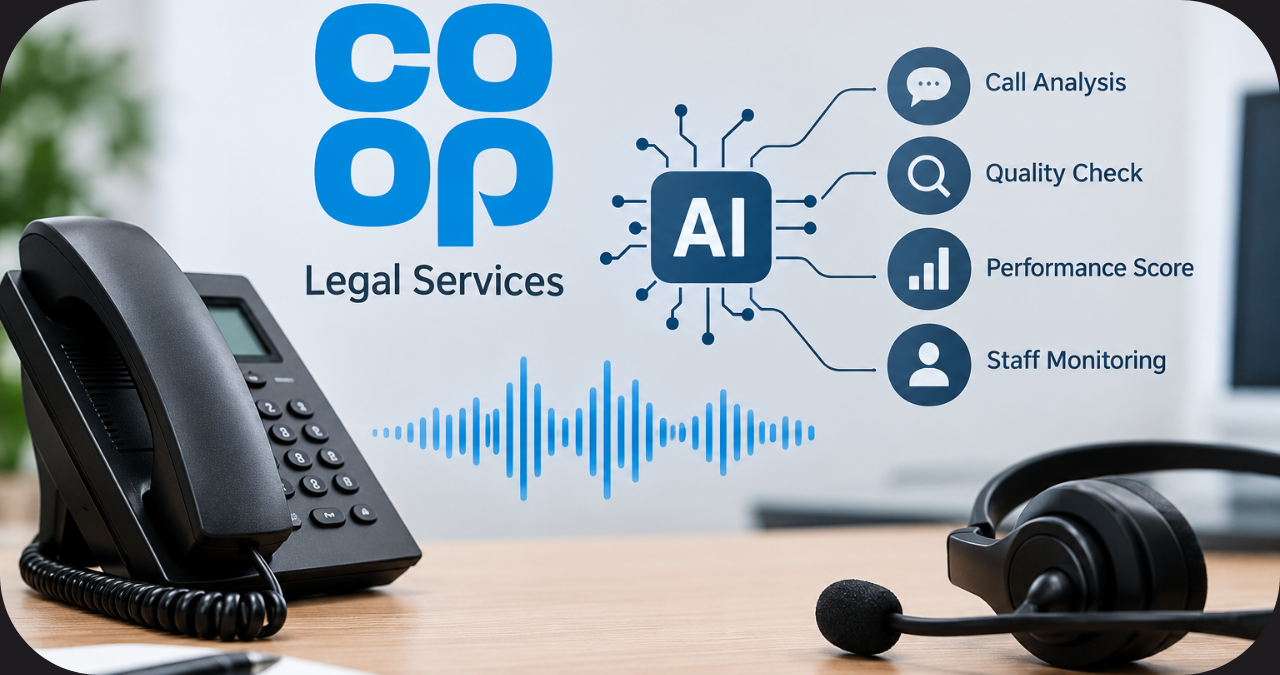
Co-op AI surveillance refers to the use of artificial intelligence by Co-op Legal Services to record, analyse and assess customer phone calls handled by some employees. The technology has attracted attention because it can examine conversations between staff and customers and produce performance assessments for managers. The calls include sensitive discussions involving wills, probate and estates, meaning employees may be speaking with people dealing with bereavement and other difficult circumstances. The system is reported to have been introduced over the past few months and affects dozens of legal-services employees.
The development has created a wider debate about how far employers should use artificial intelligence to monitor workers. Co-op says the technology is intended to support quality assurance, coaching and staff development rather than replace human decision-making. However, some workers have expressed concerns about being monitored throughout much of their working day. This disagreement has placed the Co-op system within a much larger discussion about employee privacy, workplace pressure and the growing role of AI in employment.
How the Co-op AI Monitoring System Works
The technology analyses customer conversations and assesses more than 50 different aspects of each phone call. The results can then be turned into percentage scores and pass-or-fail assessments that managers can use when reviewing employee performance. This means the system is not simply recording conversations for occasional compliance checks. It can analyse a much larger proportion of the interactions handled by participating employees.
According to reports, the AI is based on an OpenAI model that has been trained to evaluate different elements of customer conversations. The system can therefore examine how calls are handled and provide structured information to managers. Co-op says this approach allows it to review conversations more efficiently than traditional methods and identify areas where employees may benefit from coaching or development.
Why Co-op Legal Services Introduced AI Surveillance
Co-op has presented the technology as part of its broader quality-assurance approach. The company says AI allows it to review customer conversations more efficiently and helps maintain consistent standards across its legal services. The stated aim is to provide clients with expert guidance while maintaining empathy and understanding during difficult conversations.
The company also says AI can help managers provide more informed support to employees. Instead of relying only on occasional call reviews, managers can use automated analysis to identify patterns across conversations. Co-op has also indicated that the system can help identify opportunities to improve sales performance. This shows that the technology is being used for more than simple compliance monitoring.
What Employees Are Saying About the Technology
The strongest criticism has come from employees who believe the level of monitoring creates a feeling of constant observation. One anonymous Co-op worker told the Guardian that the experience felt very different from having an occasional call reviewed for compliance. The worker described the feeling of having conversations continuously analysed as oppressive and dystopian.
Concerns are particularly significant because legal-services employees can deal with customers discussing bereavement, wills, estates and probate. These conversations can require patience, empathy and careful communication. Employees concerned about AI monitoring argue that knowing every part of a conversation could be assessed may change how they feel while performing their jobs.
Co-op Defends Its Use of Artificial Intelligence
Co-op has rejected the criticism of its approach and says the AI should be understood as a support tool rather than a replacement for managers. The company says the system is not a decision-maker and that human judgement remains important when supporting employees and clients.
Caoilionn Hurley, managing director of Co-op Life Services, said the efficiency of AI makes it possible to review customer conversations more extensively. According to the company, the information can be used for support, coaching and professional development. Co-op has also stressed that human accountability, care and kindness remain central to its relationships with clients.
Why Workplace AI Monitoring Is Becoming Controversial
The Co-op case is part of a broader movement towards AI-assisted workplace monitoring. Companies can increasingly use automated systems to analyse conversations, computer activity and other forms of employee performance. Supporters argue that these systems can identify problems quickly and create more consistent performance reviews. Critics worry that constant monitoring can increase pressure and reduce employees’ sense of independence.
The International Labour Organization has warned about potential psychosocial risks associated with AI monitoring in workplaces. Concerns include increased work-related stress and the difficulty of managing risks when new technologies are introduced faster than workplace protections develop.
The Privacy Questions Behind Co-op AI Surveillance
Privacy is another important issue surrounding Co-op AI surveillance. Customer calls handled by legal-services staff can involve personal circumstances and sensitive information. At the same time, employees may want to know exactly how their conversations are analysed, who can access the results and how assessments affect their work.
The available reporting focuses mainly on the workplace-monitoring controversy and Co-op’s explanation of the system. It does not establish every technical or data-retention detail of the system. Therefore, claims about precisely how long recordings are stored or how individual pieces of customer information are processed should not be assumed without further confirmation.
Could AI Scores Affect Employee Performance Reviews?
AI-generated scores can potentially influence how managers understand employee performance. In the Co-op case, the system produces percentage and pass-or-fail assessments that managers can use when evaluating calls. The company maintains that AI is a support tool and not a decision-maker.
This distinction matters because an automated assessment does not necessarily provide the full context behind a conversation. A customer may be distressed, confused or facing unusual circumstances, and those factors can affect how a call develops. Human managers therefore remain important when interpreting AI-generated information rather than treating an automated score as a complete judgement of an employee.
How AI Surveillance Could Change the Modern Workplace
The debate around Co-op highlights a much larger question about the future of employment. Artificial intelligence is increasingly capable of analysing workplace activity at a scale that would have been difficult for human managers to achieve manually. This could make quality checks faster, but it also creates new questions about trust and employee autonomy.
If AI becomes responsible for analysing almost every customer interaction, workers may feel that they are constantly being evaluated. Employers therefore face a difficult balance between using technology to improve services and ensuring employees do not feel that automated systems have become their permanent supervisors.
Unions Raise Concerns About Automated Management
Trade unions have also criticised the growing use of AI surveillance. John Chadfield of the Communication Workers Union argued that automated systems should not become unaccountable managers. His comments reflect wider concerns that technology could intensify working conditions rather than simply make jobs easier.
The issue is not necessarily whether employers should use AI at all. Instead, the debate focuses on how these systems are introduced, what information they collect, how employees are informed and how much authority managers give to automated assessments. Clear policies and meaningful human oversight could become increasingly important as workplace AI expands.
Co-op AI Surveillance Compared With Wider AI Monitoring
The Co-op story follows other examples of companies using or testing AI to assess employees. Recent reporting has highlighted AI monitoring at technology training company Multiverse, while other businesses have explored automated systems for tracking workplace activity. Meta also paused employee keystroke monitoring following privacy concerns and staff backlash.
These examples show that workplace AI surveillance is becoming a broader technology issue rather than an isolated Co-op story. Businesses are interested in using AI to process large amounts of workplace information, while employees and unions are increasingly questioning the consequences of continuous automated assessment.
What the Co-op Case Means for Employees
For employees, the Co-op situation demonstrates why transparency can be important when AI systems are introduced into everyday work. Workers may want to understand what the technology measures, how the results are interpreted and whether an automated score can affect their employment.
For employers, the case demonstrates that technological efficiency alone may not be enough to create trust. A system can potentially improve quality assurance while still creating concerns about workplace culture. The challenge is ensuring that AI supports people instead of making employees feel that every interaction is being judged without context.
The Future of AI-Powered Workplace Surveillance
AI surveillance is likely to remain an important workplace technology issue as businesses look for faster ways to analyse employee performance. Systems capable of reviewing thousands of conversations can provide information that would be difficult for human managers to collect manually. However, the expansion of these systems is also likely to increase discussions around privacy, fairness, transparency and employee wellbeing.
The Co-op case illustrates this tension clearly. The company sees AI as a way to strengthen quality assurance and employee coaching, while critics see continuous monitoring as a potential source of stress and distrust. How businesses resolve that tension could influence workplace AI policies far beyond the legal-services sector.
What We Know About the Co-op AI Controversy
The central facts are relatively straightforward. Co-op Legal Services is using an AI system to analyse customer calls involving areas such as wills, probate and estates. The system assesses more than 50 aspects of conversations and can generate scores for managers. Co-op says the technology supports quality assurance, coaching and development, while employees and unions have raised concerns about intensive monitoring.
The controversy is therefore not simply about whether AI is being used. It is about the level of monitoring, the role of automated assessments and the effect such systems can have on employees working in sensitive customer-facing roles.
FAQs
What is Co-op AI surveillance?
Co-op AI surveillance refers to the use of artificial intelligence to analyse and assess customer calls handled by employees at Co-op Legal Services. The system examines more than 50 aspects of conversations and provides performance-related assessments.
Why is Co-op using AI to monitor calls?
Co-op says the technology supports quality assurance, coaching, employee development and more consistent customer service. The company also says it helps managers review conversations more efficiently.
Does the Co-op AI system make decisions about employees?
Co-op says the AI is a support tool rather than a decision-maker. Managers can use its assessments when reviewing employee performance, but the company says human judgement remains important.
Why are Co-op workers concerned about AI monitoring?
Some employees have raised concerns about the feeling of being continuously monitored. They argue that analysing large numbers of conversations can create pressure and reduce trust in the workplace.
What types of calls are being analysed?
The reported calls include conversations involving wills, probate and estates. These can involve customers dealing with bereavement and other sensitive personal circumstances.
Is Co-op AI surveillance part of a wider trend?
Yes. Other organisations have also explored AI systems for workplace monitoring and employee assessment. The wider trend has sparked debates about privacy, stress, transparency and the appropriate role of automated systems in managing people.
Conclusion
Co-op AI surveillance has become a major talking point because it shows how quickly artificial intelligence is moving into everyday workplace management. Co-op says its system is designed to improve quality assurance, coaching and customer service, while critics argue that constant automated monitoring could increase pressure on employees.
The story also raises a broader question about the future of work: how much workplace monitoring is useful, and when does monitoring become excessive? As AI becomes more capable of analysing conversations and employee performance, businesses will increasingly need to balance technological efficiency with privacy, trust, human judgement and workplace wellbeing.
